By Conor Bentley MAAT, AAT Licensed Accountant and founder of Expand Accounts.
What is the domestic reverse charge?
Quick answer: Domestic reverse charge VAT, often shortened to DRC, means a VAT registered subcontractor does not charge VAT on construction services reported under CIS. Instead, the VAT registered contractor receiving the work accounts for that VAT on their own VAT return and normally reclaims it on the same return. It has applied since 1 March 2021, unless the customer confirms in writing that they are an end user.
If you are a VAT registered subcontractor, the reverse charge affects what goes on your invoices and how much money reaches your bank each month. Get your invoices wrong and HMRC can ask you for VAT you never actually received, so it is well worth getting right. This guide explains the rules in plain English, with a worked example you can compare your own invoices against.
In this guide
- How the reverse charge works in practice
- When does domestic reverse charge VAT apply?
- End users and intermediary suppliers
- The 5% rule
- Does the reverse charge apply to materials?
- How the reverse charge works alongside CIS
- A worked example
- What your invoice must say
- How it shows on your VAT return
- What it does to your cash flow
- Common reverse charge mistakes we see
- Domestic reverse charge FAQs
How the reverse charge works in practice
In simple terms, the reverse charge moves the job of dealing with VAT from the subcontractor to the contractor who hires them.
It used to be that you added 20% VAT to your invoice and later paid it over to HMRC. Now you send your invoice without VAT, and the contractor sorts out the VAT on their own VAT return instead.
For the contractor, this usually costs nothing, because they record the VAT and claim it back at the same time. For you, it means the VAT no longer passes through your bank account, which makes a real difference to your cash flow, as we explain further down.
HMRC brought this in on 1 March 2021 to stop VAT going missing in the construction supply chain. You can read HMRC’s own summary in its guidance on when you must use the VAT domestic reverse charge, and our guide to VAT in the construction industry covers the basics of VAT for builders.
When does domestic reverse charge VAT apply?
The reverse charge applies when every one of these is true:
- You are VAT registered in the UK and your customer is too.
- Payment for the work is reported under the Construction Industry Scheme.
- The work is standard rated or reduced rated, not zero rated.
- You are not an employment business supplying staff or workers.
- Your customer has not told you in writing that they are an end user or intermediary supplier.
If any one of those fails, you charge VAT in the normal way. HMRC’s checklist for suppliers is in its guide on how to use the reverse charge if you supply building and construction services.
The services covered match the “construction operations” in CIS, so building, repairs, groundworks, installing heating, electrics and drainage, painting and decorating, scaffolding and site clearance all count. On the other hand, architects and surveyors, installing security systems, and delivering materials on their own fall outside it. If you are unsure whether a job sits inside CIS at all, our guide on what CIS is and who it applies to is the place to start.
End users and intermediary suppliers
An end user is a VAT and CIS registered business that buys construction work but does not sell it on, such as a developer building offices to keep, or a business extending its own premises. An intermediary supplier is connected to an end user, for example a landlord passing work through to its tenant, or a company in the same group.
Neither is automatic. Your customer only becomes an end user for reverse charge purposes once they tell you in writing, whether by email or in the contract itself. Until you have that notice, HMRC says you should still apply the reverse charge if they are VAT and CIS registered. Keep every notice on file, since it is your evidence if HMRC ever asks why you charged VAT.
Two situations catch people out. Firstly, homeowners are never end users, because they are not VAT registered, so a job for a private client is simply charged with normal VAT. Secondly, a main contractor working for that homeowner does not become the end user either, which means your invoices to that contractor still fall under the reverse charge.
The 5% rule
If the reverse charge element of a contract is 5% or less of its total value, you can ignore it and charge VAT normally. A classic example is a joiner who builds a staircase in the workshop and charges a small amount to fit it on site.
However, the rule only works if you and your customer agree at the start of the contract, based on the overall contract values. You cannot apply it invoice by invoice, and it does not apply where the main part of the job is zero rated new build housing.
Does the reverse charge apply to materials?
Yes, in most cases. When you supply materials as part of the job, HMRC treats the labour and materials as one supply, so the reverse charge covers the full value of the invoice.
Splitting the job does not change that. Sending separate invoices for supply and fix on the same order, or writing separate labour and materials contracts for the same site, still leaves the whole lot under the reverse charge. The exceptions are materials sold on their own with no labour, and plant or goods hired without an operator, both of which sit outside CIS and take normal VAT.
How the reverse charge works alongside CIS
CIS and the reverse charge run side by side, but they are calculated on different figures:
- CIS is deducted from the labour element only, at 20% if you are registered, 30% if you are not, or nothing with gross payment status.
- The reverse charge applies to the whole invoice, labour and materials together.
We explain the CIS side in more depth in our guide to CIS deduction rates, and if you want to stop CIS being taken altogether, see how to get gross payment status.
A worked example
Smith Brickwork Ltd is a VAT registered subcontractor with CIS deducted at 20%. It invoices a main contractor for a month’s work: £10,000 of labour and £2,000 of materials.
| Line | Before the reverse charge | With the reverse charge |
|---|---|---|
| Labour | £10,000 | £10,000 |
| Materials | £2,000 | £2,000 |
| VAT at 20% | £2,400 added to the invoice | £0 charged, £2,400 shown as “customer to account” |
| Invoice total | £14,400 | £12,000 |
| Less CIS at 20% of labour | (£2,000) | (£2,000) |
| Cash Smith Brickwork receives | £12,400 | £10,000 |
On the other side, the main contractor records £2,400 of output VAT on its return and reclaims £2,400 as input VAT on the same return, so it pays HMRC nothing extra. Smith Brickwork, meanwhile, receives £2,400 less each month. That money was never theirs to keep, yet many subcontractors used to rely on holding it until their VAT return was due.
What your invoice must say
A reverse charge invoice still needs everything a normal VAT invoice shows, including your VAT number and a description of the work. On top of that, it must:
- state clearly that the domestic reverse charge applies and the customer must account for the VAT
- show the amount of VAT due under the reverse charge, or the rate if your software cannot show the amount, without adding it to the total payable
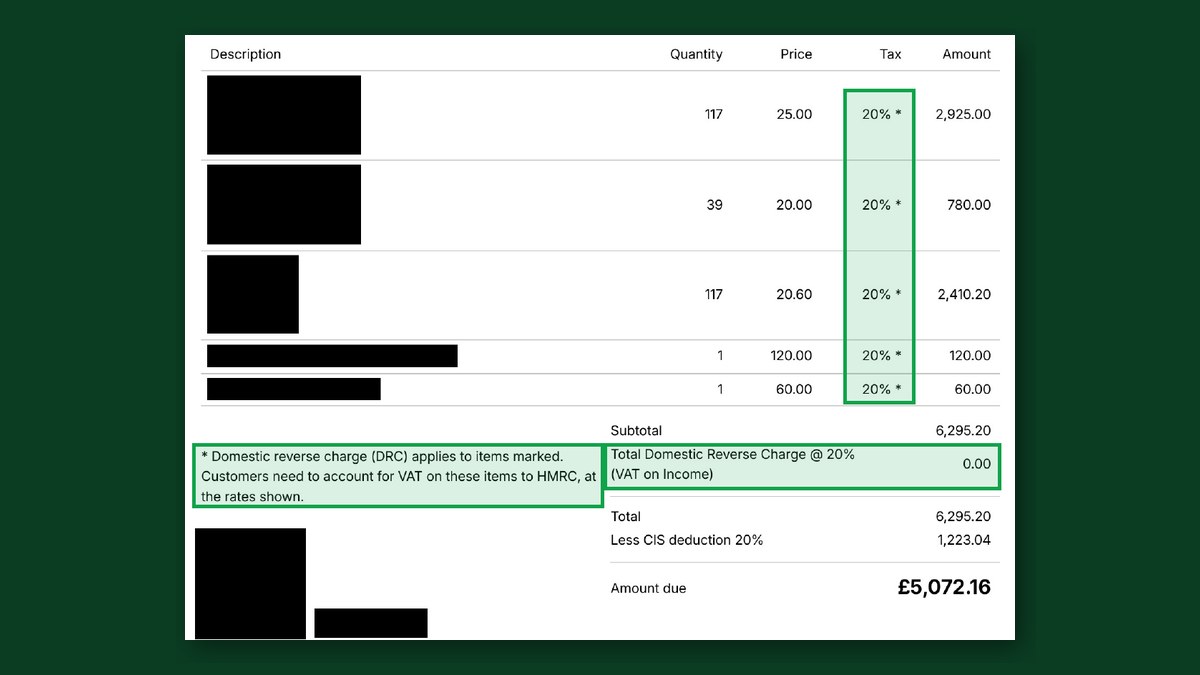
HMRC accepts wording such as “Reverse charge: VAT Act 1994 Section 55A applies” or “Reverse charge: customer to pay the VAT to HMRC”. Xero, QuickBooks and most construction software have a reverse charge tax rate built in. In Xero, for example, choose “Domestic Reverse Charge @ 20% (VAT on Income)” on your sales invoices and it will add the wording for you. Our overview of cloud accounting for construction businesses explains how to get that kind of setup working.
How it shows on your VAT return
As the subcontractor, you include the net value of the sale on your return but no output VAT. As the contractor, you add the reverse charge VAT to your output tax and reclaim it as input tax on the same return, and you do not record the purchase as a sale.
Two VAT schemes stop working the way you might expect. You cannot use the Cash Accounting Scheme for reverse charge work, although you can keep it for your other sales. Reverse charge sales are also excluded from the Flat Rate Scheme, and because that scheme does not let you reclaim VAT on materials and overheads, many subcontractors find it no longer pays to stay on it. HMRC covers both points in its reverse charge technical guide.
What it does to your cash flow
The biggest change for a subcontractor is that VAT stops coming in, while you still pay VAT on your materials, van, fuel and tools. As a result, many subcontractors move from paying HMRC to being owed a repayment every quarter.
Waiting three months for that money can squeeze a growing business. HMRC lets you switch to monthly VAT returns through your online VAT account, so repayments arrive sooner. If all or most of your income is reverse charge or zero rated, that switch alone can free up thousands of pounds of working capital. Our guide to cash flow planning for construction businesses shows how to forecast around it.
Common reverse charge mistakes we see
- Charging VAT to a contractor out of habit. If the reverse charge applies and you charge VAT anyway, the contractor cannot properly reclaim it and the invoice has to be corrected.
- Applying the reverse charge to an end user without checking. If your customer has sent an end user notice, you charge normal VAT. Ask the question at the start of every new contract.
- Splitting labour and materials to keep the materials outside the reverse charge. HMRC treats them as one supply, so this does not work.
- Using the 5% rule invoice by invoice rather than agreeing it on the whole contract at the outset.
- Not checking your customer’s status. Use HMRC’s online service to confirm they are VAT and CIS registered, as you would when verifying a subcontractor.
- Applying it to zero rated new build housing, where the reverse charge does not apply at all.
In our experience, the costliest mistakes are simple invoicing errors. A wrong VAT line can hold up payment while the invoice is corrected, and some subcontractors end up paying VAT over to HMRC that should never have been charged in the first place. Getting your invoices right from the start keeps money coming in on time, so you hold on to your working capital for longer and the rest of the business benefits.
HMRC asks businesses to correct reverse charge errors as soon as they find them, as the longer an error sits, the harder it is to recover overpaid VAT or settle what is owed.
Domestic reverse charge FAQs
Who pays the VAT under the domestic reverse charge?
The customer receiving the construction work, usually the main contractor, accounts for the VAT on their own VAT return and normally reclaims it on the same return. The subcontractor does not charge or pay it.
What does DRC VAT mean?
DRC stands for domestic reverse charge. DRC VAT is the VAT on construction work that the customer accounts for under the reverse charge, rather than the subcontractor adding it to their invoice.
Is the CIS reverse charge the same as the domestic reverse charge?
Yes. People often call it the CIS reverse charge because it only applies to work reported under CIS, while HMRC calls it the VAT domestic reverse charge for building and construction services. You will also see it described as the VAT reverse charge for construction. CIS itself is a separate scheme that deducts tax from the labour part of your invoice.
Does the reverse charge apply to private homeowners?
No. Homeowners are not VAT registered, so work for a private client is charged with VAT in the normal way. However, if you are subcontracting to a builder who works for that homeowner, your invoices to the builder still fall under the reverse charge.
Does the reverse charge apply to labour only subcontractors?
Yes. A labour only subcontractor who prices and takes responsibility for the work is supplying construction services, so the reverse charge applies. An employment business supplying staff on timesheets is treated differently and charges VAT normally.
Can I still reclaim VAT on my materials and costs?
Yes. You reclaim input VAT on your purchases in the usual way. With little or no VAT coming in, that often leaves you due a repayment from HMRC.
Does the reverse charge apply to new build houses?
Not to zero rated work. Building new homes is usually zero rated, so there is no VAT to reverse. It can still apply to standard rated work on a new build site, unless the customer is an end user.
What happens if I get the reverse charge wrong?
Correct it as soon as you spot it, normally by issuing a credit note and a new invoice. HMRC may assess for the VAT involved, so it pays to have someone check your setup before it builds into a bigger bill.
Want the reverse charge handled for you?
If you would rather spend your time on site than checking VAT codes, we can check your invoices and set up your software so the reverse charge takes care of itself. Find out more about our CIS accountancy services or book a call with Conor.